
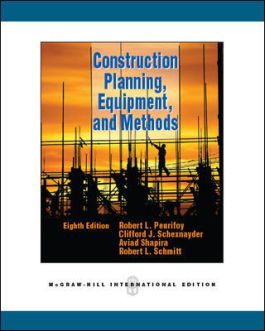
EBOOK: Construction, planning, equipment and methods
- Access the eBook anytime, anywhere: online or offline
- Create notes, flashcards and make annotations while you study
- Full searchable content: quickly find the answers you are looking for
Chapter 1: Machines Make it Possible
Chapter 2: Equipment Economics
Chapter 3: Planning for Earthwork Construction
Chapter 4: Soil and Rock
Chapter 5: Compaction and Stabilization Equipment
Chapter 6: Mobile Equipment Power Requirements
Chapter 7: Dozers
Chapter 8: Scrapers
Chapter 9: Excavators
Chapter 10: Trucks and Hauling Equipment
Chapter 11: Finishing Equipment
Chapter 12: Drilling Rock and Earth
Chapter 13: Blasting Rock
Chapter 14: Aggregate Production
Chapter 15: Asphalt Mix Production and Placement
Chapter 16: Concrete and Concrete Equipment
Chapter 17: Cranes
Chapter 18: Piles and Pile-Driving Equipment
Chapter 19: Air Compressors and Pumps
Chapter 20: Forming Systems
Chapter 21: Planning for Building Construction
Appendix A – Alphabetical List of Units with Their SI Names and Conversion Factors
Appendix B – Selected English-to-SI Conversion Factors
Appendix C – Selected U.S. Customary (English) Unit Equivalents
Appendix D – Selected Metric Unit Equivalents
Index
Robert. L. Peurifoy (1902–1995), after serving as principal specialist in engineering education for the U.S. Office of Education during World War II, began teaching construction engineering at Texas A&M University in 1946. In the years that followed, Peurifoy led the transformation of the study of construction engineering into an academic discipline. In 1984 the Peurifoy Construction Research Award was instituted by the American Society of Civil Engineers upon recommendation of the Construction Research Council. This award was instituted to hon Renewal Technical Coordinating Committee.
Aviad Shapira is an Associate Professor of Construction Engineering and Management in the Faculty of Civil and Environmental Engineering at the Technion–Israel Institute of Technology. He joined with Dr. Schexnayder in 2004 to author the 7th edition of this book.
Robert L. Schmitt is a Professor of Civil Engineering at the University of Wisconsin, Platteville campus. He received his Ph.D. in civil engineering (construction engineering and management) from the University of Wisconsin, a Master’s in civil engineering from Purdue University, and a Bachelor’s in civil engineering from the University of Wisconsin, Platteville

McGraw Hill Connect is an award-winning digital teaching and learning solution that empowers students to achieve better outcomes and enables instructors to improve course management efficiency.
High-Quality Course Material
Our trusted solutions are designed to help students actively engage in course content and develop critical higher-level thinking skills while offering you the flexibility to tailor your course to the ways you teach and the ways your students learn.
Assignments & Automatic Grading
Connect features a question bank that you can select from to create homework, practice tests and quizzes. Dramatically reduce the amount of time you spend reviewing homework and grading quizzes, freeing up your valuable time to spend on teaching.
Analytics & Reporting
Monitor progress and improve focus with Connect’s visual and actionable dashboards. Reports are available to empower both instructors and students with real-time performance analytics.
Seamless Integration
Link your Learning Management with Connect for single sign-on and gradebook synchronization, with all-in-one ease for you and your students.